 TruVet Pet Care Clinic
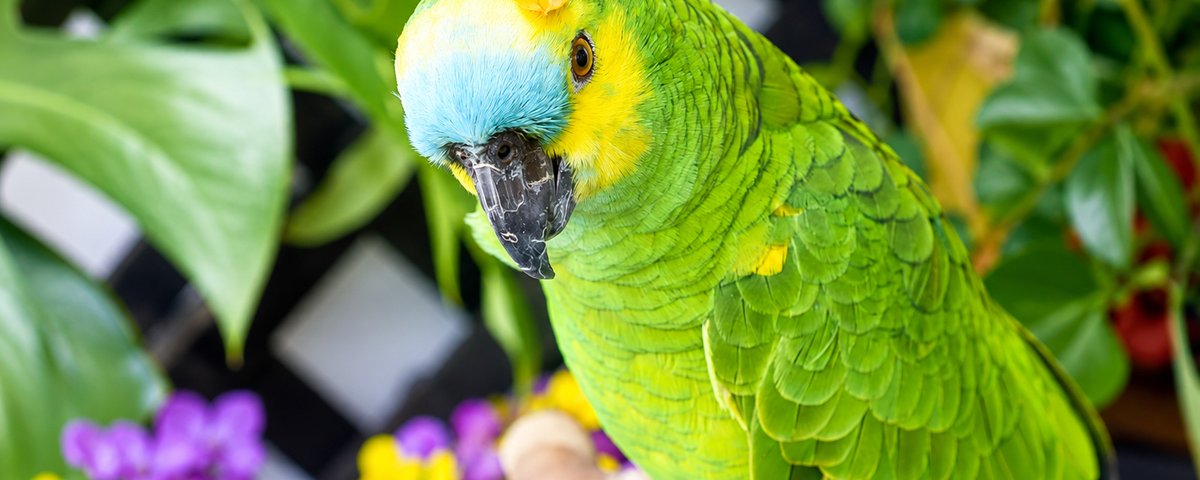
For decades, a talking parrot was assumed to be simply mimicking sounds with no real understanding behind them. One extraordinary bird, and thirty years of research, changed that completely.
Can Parrots Really Understand What They're Saying? The Science of Avian Intelligence
By Dr. Brajmadhuri, TruVet Pet Care Clinic, Sector 79, Gurgaon
For decades, a talking parrot was assumed to be simply mimicking sounds with no real understanding behind them. One extraordinary bird, and thirty years of research, changed that completely.
For most of scientific history, calling someone a birdbrain was an insult, shorthand for someone lacking real intelligence. A parrot repeating a phrase back to its owner was assumed to be doing exactly that, mimicking a sound with no genuine understanding of what it meant, the same way a recording might play back a voice. One extraordinary African Grey parrot, and the scientist who spent thirty years studying him, fundamentally changed that assumption.
Meet Alex, and the scientist who studied him
In 1977, animal psychologist Dr. Irene Pepperberg bought an African Grey parrot from an ordinary pet shop, specifically to study whether birds were actually capable of the kind of complex thinking previously believed to be limited to primates and a handful of other highly intelligent mammals. She named him Alex, and over the following three decades, their work together became one of the most significant studies in the entire field of animal cognition.
What Alex could actually do
By the end of his life, Alex could identify, categorise, and describe more than fifty different objects, along with seven colours and five different shapes, using around 150 words. This alone would be notable, but what made Alex's abilities genuinely remarkable was that he was not simply repeating labels attached to specific objects. He understood categories, meaning he could correctly answer questions about what colour an object was, what shape it was, or what material it was made from, even when presented with combinations he had never specifically been trained on before.
Perhaps most strikingly, Alex demonstrated an understanding of the concept of zero, correctly indicating when a set contained no items of a particular type. This is a genuinely abstract mathematical concept that human children typically do not grasp until around four years of age.
Why this genuinely counts as understanding, not mimicry
The distinction between mimicry and real comprehension is exactly what Dr. Pepperberg's research was designed to test. If Alex were simply repeating memorised phrases without understanding, he would not have been able to correctly apply labels to entirely new combinations of objects he had never encountered in that specific arrangement before. Pepperberg adapted testing methods originally developed for studying reasoning in chimpanzees, and Alex passed comparable tests, correctly identifying whether two objects were the same or different, and specifically in what way, colour, shape, or material, a level of abstract reasoning that few animals of any kind have been shown to possess.
How Alex was actually trained
Pepperberg used a particular training method involving two human trainers, where one trainer would ask questions and reward correct answers while the other trainer modelled the correct response, essentially demonstrating for Alex what a good answer looked like. This method leaned on the social, competitive learning that comes naturally to a highly social species like the African Grey, rather than the simpler reward based repetition used in more traditional animal training. Over time, this approach gave Alex genuine, functional use of language, including asking for things he wanted and using appropriate emotional language, correctly saying sorry in fitting contexts, for example.
What this tells us about parrot intelligence more broadly
Pepperberg's assessment placed Alex's cognitive abilities in a similar range to dolphins and great apes in several respects, and noted that his communicative ability was comparable to that of a two to three year old human child in some specific areas. This was not a claim that parrots think exactly like humans do, but rather evidence that a brain the size of a shelled walnut, as Pepperberg herself has described it, is capable of remarkably sophisticated cognition, challenging decades of assumptions built around brain size alone as a proxy for intelligence.
What this means for the parrots people actually keep as pets
Alex was a specific research subject working with a dedicated scientist across thirty years, and this level of demonstrated ability is not something every pet parrot will replicate. That said, the underlying finding matters directly for anyone who owns or is considering a pet bird. Parrots in general, not just African Greys specifically, are now understood to be genuinely intelligent, socially complex animals that need real mental engagement, not simply a cage, food, and the occasional word repeated back to them. A parrot kept without adequate mental stimulation is considerably more prone to stress related behaviours, including feather plucking and excessive screaming, precisely because an intelligent, socially wired animal is not getting the engagement it genuinely needs.
The TruVet takeaway
The old assumption that a talking parrot is simply mimicking sound with nothing behind it does not hold up against thirty years of rigorous research. Alex demonstrated genuine categorisation, abstract reasoning, and even an understanding of zero, abilities that place parrot cognition in a category few people would have expected before Pepperberg's work began. If you share your home with a parrot, this research is a good reminder that real mental engagement, not just food and a cage, is genuinely part of what he needs to thrive.
TruVet Pet Care Clinic is at Shop No 4-6, opposite Bestech Park View Altura, Sector 79, Naurangpur, Gurugram, Haryana 122051. Dr. Brajmadhuri personally examines every patient, and we are open all seven days from 10am to 8pm for OPD consultation, vaccination, deworming, surgery, and health checkups for a range of pets. WhatsApp us at +91 98710 10355 if you have questions about your pet bird's health or wellbeing.
Frequently asked questions.
Does this mean every parrot can learn to talk and understand words the way Alex did?
Not necessarily to the same extent, since Alex was a dedicated research subject worked with intensively over thirty years. That said, the underlying cognitive capacity Pepperberg's research revealed is now understood to exist broadly across parrot species, even if individual training and engagement vary considerably.
Are some parrot species smarter than others?
Research has focused most heavily on African Grey parrots specifically, given their strong verbal and cognitive abilities, though other species, including macaws and cockatoos, are also considered highly intelligent and socially complex.
My parrot repeats phrases but does not seem to use them meaningfully. Is that normal?
Yes, this is common, and it does not mean your parrot lacks intelligence. The level of functional, contextual language use Alex demonstrated came from a specific, intensive training approach over many years, and most pet parrots simply have not had that same structured engagement.
How can I provide better mental stimulation for my pet parrot?
Regular social interaction, puzzle toys, foraging opportunities that mimic natural feeding behaviour, and varied daily engagement all help meet a parrot's genuine cognitive needs, considerably more than a cage and occasional attention alone.
Can a lack of mental stimulation actually cause health problems in parrots?
Yes, insufficient mental engagement is strongly linked to stress related behaviours in parrots, including feather plucking and excessive vocalisation, which can become genuine welfare and health concerns over time.
Is it true that parrots can live for many decades?
Yes, many parrot species, particularly larger ones like African Greys and macaws, can live 40 to 60 years or more in captivity, which is worth factoring in as a genuine long term commitment before bringing one home.
Questions for Dr. Brajmadhuri?
Open all 7 days, 10am to 8pm. Walk-in OPD welcome.